Your Closet Has Data. Here's What It's Saying.
Your real style isn't the clothes you own. It's the ones you keep reaching for. Time to look at the numbers.
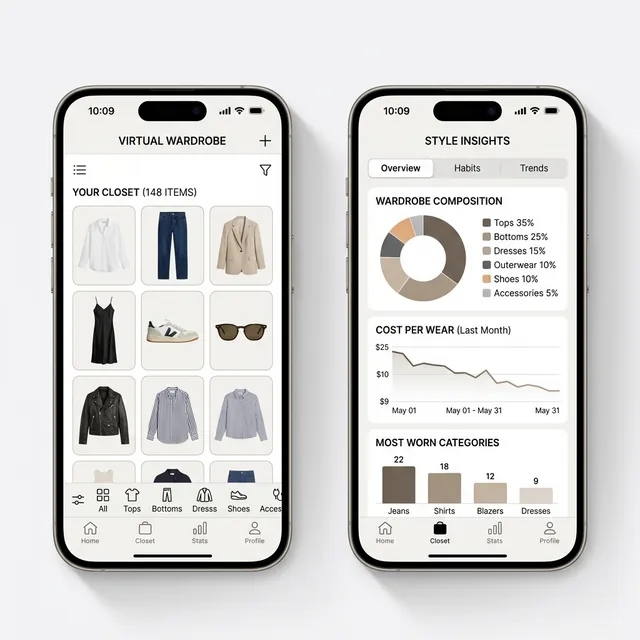
You have a closet full of clothes and nothing to wear. You also wore the same four things all month. Both of these are true, and both are data.
Most of us dress on autopilot, so we have surprisingly little idea what we actually wear. We remember the jacket we bought and forget that it's left the house twice. Once you start tracking, the picture changes fast.
The number that changes how you shop
Cost per wear is simple: price divided by how many times you've worn it.
Take a $120 pair of boots you wear 60 times. That's $2 a wear. Now take a $40 top you bought in a hurry and wore twice. That's $20 a wear. The "cheap" top cost ten times as much as the boots.
The bargain is whatever you keep wearing. The price tag was only ever half the math.
Before buying anything, ask yourself whether you'd honestly wear it thirty times. If the answer is "maybe, for a specific party," that's useful information.
Your most-worn list is your real aesthetic
There's the person you dress as in your head, and there's the person your laundry knows. If your most-worn list is two hoodies and one pair of baggy jeans, you're not a tailoring person who's temporarily busy. You're a streetwear person with a blazer you feel guilty about.
That's good news. It means you can stop buying for the imaginary you and get better at dressing the real one.
Watch your colors drift
Color is where tracking gets interesting. Look back across a month of fits and you may find you've gone all earth tones without ever deciding to. Maybe your best-rated fits all share a palette. Maybe that bright shirt keeps turning up on your lowest days. You won't spot any of that one outfit at a time.
Three questions for every month
- What earned its spot? The pieces you wore over and over, and that scored well. Look after those. Buy things that go with them.
- What's dead weight? The pieces that haven't appeared at all. Give them one last shot this month, then sell or donate them.
- What's the gap? The missing thing that keeps hurting your fits. Maybe every outfit needs a better shoe, or a neutral layer. Now you know exactly what to buy, and it's one item instead of ten.
You don't have to log any of this
This is why we built the Virtual Wardrobe to run itself. Every fit you check is saved automatically, so your aesthetic timeline builds without you thinking about it. On the 1 Month and 3 Month plans, the Monthly Report turns that history into visual analytics on your most-worn pieces, aura growth and color trends.
No spreadsheets. Just the thing your closet has been trying to tell you.